
Three Years to Reinvent the Men's Boxer Brief
Three Years to Reinvent the Men's Boxer Brief
Behind every simple idea are countless invisible decisions.
Every great invention begins with a question.
Mine was surprisingly simple.
Why has no one ever redesigned men's underwear?
At first, I wasn't trying to invent a new product.
I was trying to solve a problem that millions of men experience every day without even thinking about it.
What followed wasn't inspiration.
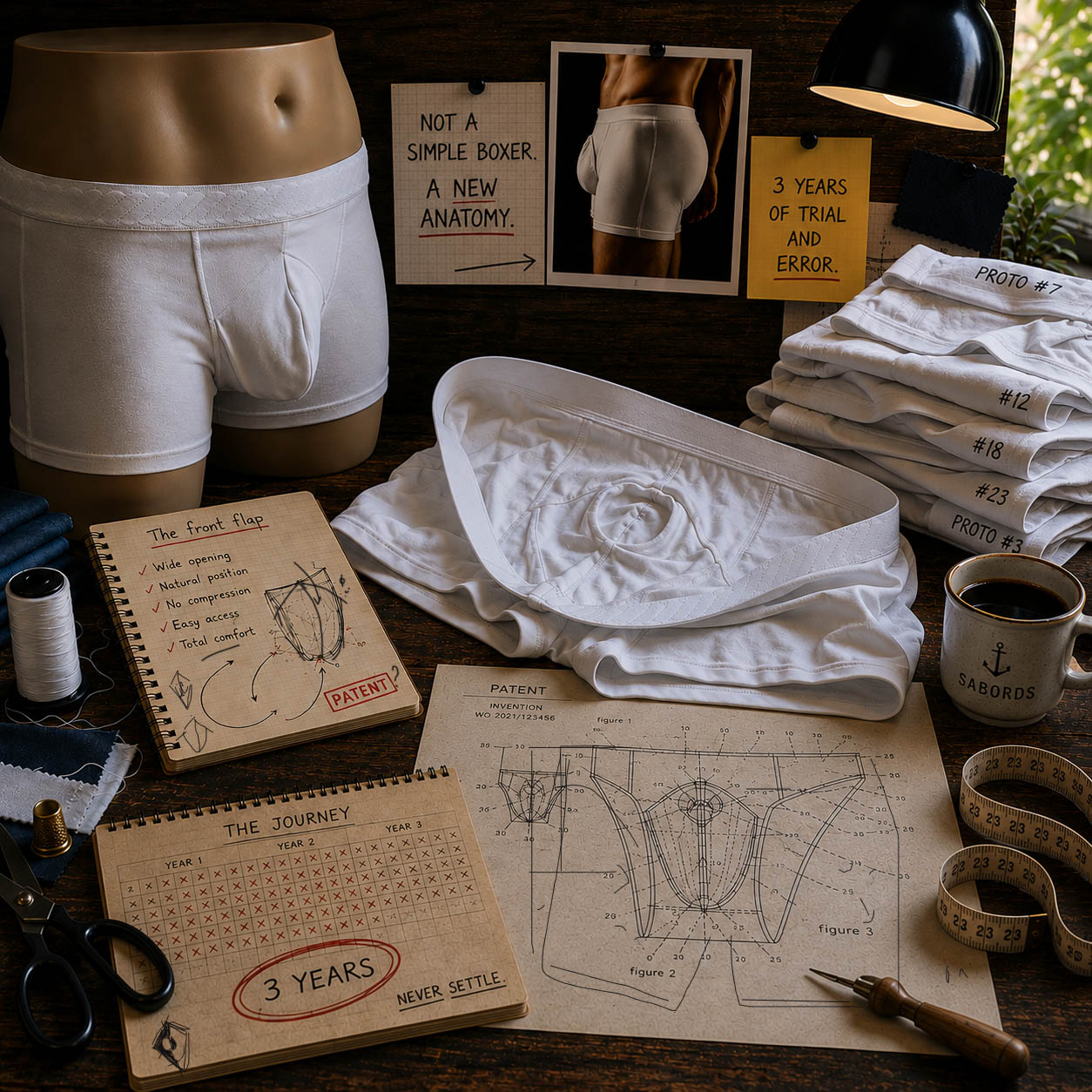
It was three years of sketches, hand sewing, prototypes, failures and constant improvements.
Looking back, I realized something.
The most difficult innovations are rarely the most complicated ones.
They're often the simplest.
This is that story.
The First Hand-Sewn Experiments
As a child, I often watched my mother sewing at the kitchen table.
She made many of her own dresses.
She also made many of my clothes.
What fascinated me most weren't the finished garments.
It was the small pieces of fabric scattered around the sewing machine.
To me, they looked mysterious.
They were the remains of clothes that didn't exist yet.
Decades later, those memories came back almost naturally.
For the first time, I picked up a needle and thread myself.
I wasn't trying to make beautiful underwear.
I was trying to solve a problem.
I wanted to understand.
How could this protective front flap stay in place?
What should its curve look like?
Where should it be attached?
How could it cover naturally without lifting by itself?
After countless attempts — some of them completely absurd — I finally had something that vaguely resembled what I had imagined.
The opening was almost in the right place.
The flap existed.
Sort of.
The basic concept was there.
Now it needed to become a real prototype.
The First Manufacturing Workshop
That is when Héritage Confection entered the story, a small workshop near Noirmoutier, on the French Atlantic coast.
At the time, they offered a package that included pattern making and three prototypes.
For me, it was exactly what I needed.
This was also where I discovered an entire profession I had never heard of before:
the pattern maker.
Working alongside the seamstresses, the pattern maker transformed my sketches into precise industrial patterns.
Every panel had to be drawn.
Every seam had to be planned.
Every construction detail mattered.
Apparently, I made quite an impression.
The seamstresses laughed when they discovered this strange boxer brief unlike anything they had ever made before.
The very first prototype was created in an atmosphere of curiosity, humor and genuine enthusiasm.
No one in that workshop had ever built men's underwear quite like this.
When Every Prototype Creates New Problems
The hardest part?
Fixing one problem almost always created another.
Move one seam...
and another one changes tension.
Adjust one attachment point...and the fabric falls differently.
Correct one detail...two new flaws appear.
It almost felt as if the prototype refused to be finished.
Between each prototype, I often waited nearly two months.
Two months to discover whether an idea actually worked.
Two months...
only to realize I had to start over again.
The Seamstress Who Solved It
One day, while I was explaining exactly how I wanted the front flap to behave, one of the seamstresses suggested assembling the pieces differently.
Just a few stitches.
Nothing spectacular.
An invisible manufacturing detail.
But it solved a problem I had been fighting for months.
That solution never appeared in the patent.
It belongs to craftsmanship.
To experience.
To the intelligence of the people who actually build things.
Back to Square One
After dozens of prototypes, countless invisible modifications and far more iterations than I had ever imagined...
I finally held the two models I had envisioned from the very beginning.
I thought the hardest part was over.
I was wrong.
Just as I was preparing the first production run, I learned the workshop was going out of business.
It closed.
Overnight.
Three years of work suddenly had nowhere to go.
I was back to square one.
Discovering Troyes
Looking for manufacturers still producing underwear in France eventually led me to Troyes.
For centuries, Troyes has been the historic heart of French hosiery and underwear manufacturing.
Walking through its medieval streets while developing SABORDS often gave me the same feeling.
There was something timeless about the design I was trying to create.
The final solution wasn't based on complicated technology.
It was based on simplicity.
Sometimes the most modern ideas are the ones that look as though they could have existed centuries ago.
Perhaps that's why Troyes felt like the perfect place to finish this journey.
Even the SABORDS logo seemed to belong there.
Its shield-like shape, almost a modern coat of arms, echoed the medieval character of Troyes and the idea of a product built to protect, support and last.
Testing in Real Life
The most important testing never happened inside the workshop.
It happened in everyday life.
Walking.
Driving.
Working.
Climbing stairs.
Sitting.
Living.
Week after week, I wore every prototype in every situation I could think of.
I wanted to create underwear I could wear every single day.
If I ever felt the urge to change something...
it wasn't ready.
That became my rule.
Always question.
Always improve.
Never compromise.
Three Years Later
When this adventure began, I knew absolutely nothing about garment construction.
Nothing about pattern making.
Nothing about fabric weights.
Nothing about industrial sewing.
Nothing about textile manufacturing.
I started with nothing more than a needle, some thread and an idea.
Three years later, I was holding an entirely new kind of men's boxer brief.
An invention that eventually became a patented design.
But...
that's another story.
Every prototype shown below is real.
Some solved one problem.
Others created three new ones.
Together, they tell the true story behind SABORDS.